

Why 500+ Bed Hospitals Are Becoming Dead Stocks
Large hospitals sit at 55–65% occupancy. Hub-and-spoke networks are scaling faster, at lower cost.
1 min read
A book for hospital leaders
Most hospitals don't fail because of bad medicine. They fail because the person who built the hospital was rarely trained to run it.
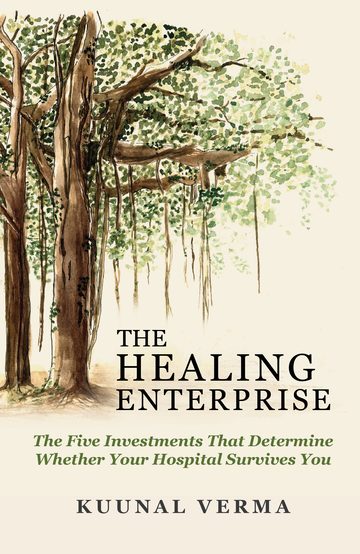
The Five Investments That Determine Whether Your Hospital Survives You
Prices as listed by each retailer on . The retailer's page shows the current price.
From the book's back cover. Select a name to read the endorsement.
Few books on healthcare leadership are as original, insightful, and deeply relevant as "The Healing Enterprise". Kuunal Verma reminds us that the true measure of a healthcare institution is not merely its scale or success, but its ability to endure, evolve, and serve with purpose.
The five investments defined in this book are management disciplines which have never been defined in this manner. I would strongly recommend this to every hospital owner.
Strong fundamentals and values deeply embedded in the culture survive transitions, and those values are truly reflected in this book.
Finally, we have a book which is centred on the core principles of managing hospitals successfully. It is an absolute essential read for doctors involved in hospital administration.
Written for the people who carry a hospital on their shoulders.
Who built the hospital and still carry it.
Who run the hospital day to day.
Who answer for the hospital's future.
Who are brilliant at care and ready to master everything else.
Each chapter pairs a hard financial reality with a story you will not forget, and ends with a provocation that turns insight into action.
The financial truths a hospital must face early, before they show up on the balance sheet.
The relationships that carry a hospital through its hardest years.
How to build a hospital that outlasts its founder, not one that ends with them.
The framework at the heart of the book.
Knowledge
Explored in the book.
Judgment
Explored in the book.
Capital
Your institution's relationship with money. What it believes money is for. Capital treated not as a rescue in a crisis, but as a resource cultivated over years.
Relationships
Explored in the book.
Stewardship
The care a mother gives without being asked. Loving the institution enough to make yourself unnecessary.

About the author
Free chapter
See how the book opens, and whether it speaks to your hospital, before you buy it.
Would your hospital keep working if you stepped away for ninety days? Start with the 90-Day Founder Test, then discuss your hospital's priorities with Kuunal.
Ordering for a board, a leadership team, a medical college or a conference? Tell us the quantity, city and date. We reply within two working days with institutional pricing.
Kuunal can lead a session on the book with your hospital team or board. Tick the option in the form, or see his talks.
Hospital founders, doctor-owners, CEOs, trustees, administrators and healthcare leaders: the people who carry a hospital on their shoulders.
The book's framework of five investments: Vidyā (knowledge), Viveka (judgment), Vittam (capital), Vibandha (relationships) and Vātsalya (stewardship). Together they turn ancient wisdom into a modern operating discipline.
The truths that decide a hospital's future: why billing is not revenue, why the right relationships protect an institution, and why succession is the real test of leadership.
A 309-page paperback (6 × 9 inches) and a Kindle ebook.
From Pothi, at ₹649 plus shipping. Orders are dispatched in 5–7 business days.
Pothi ships within India only. Outside India, order the paperback from Amazon.com.
Yes. Send a bulk-order enquiry with the quantity, delivery city and date. We reply within two working days with institutional pricing.
Yes. Kuunal can lead a session on the book for a hospital team or board. Tick the option in the bulk-order enquiry, or see the speaking page.
Yes. Request the first chapter on this page and we will email it to you.
Start with hospital capacity, financial decisions and the founder's role.
Large hospitals sit at 55–65% occupancy. Hub-and-spoke networks are scaling faster, at lower cost.
1 min read
The hidden costs of operational inefficiency: most Tier-2 hospitals have a leakage problem, not a revenue problem.
2 min read
Hospitals rarely collapse due to external competition. They decline quietly from the inside.
1 min read
Share the book
Follow Kuunal's writing: The Healing Enterprise newsletter on LinkedIn (opens in a new tab).
Read the book?
Your feedback goes straight to Kuunal. We publish a reader's words only with their permission.


 Share on WhatsApp